Showing posts with label environmentalism. Show all posts

Monday, March 25, 2013

Norman Borlaug Answers His Critics

Today would have been Dr. Norman Borlaug's 99th birthday. His long and fruitful life came to a end on September 2, 2009 at the age of 95.

Toward the end of his life, Dr. Borlaug, justifiably called "The Father of the Green Revolution" and "The Man Who Saved a Billion Lives," was the target of vicious and unrelenting criticism from a gaggle of radical "greens" – so-called "environmentalists" who long to return the earth to a state of nature and would, if they had the power, eliminate humanity, except, of course, for themselves.

Here is Dr. Borlaug's reply to his critics:

"Some of the environmental lobbyists of the Western nations are the salt of the earth, but many of them are elitists. They've never experienced the physical sensation of hunger. They do their lobbying from comfortable office suites in Washington or Brussels. If they lived just one month amid the misery of the developing world, as I have for fifty years, they'd be crying out for tractors and fertilizer and irrigation canals and be outraged that fashionable elitists back home were trying to deny them these things."

Sunday, August 9, 2009

Banning of Pre-1985 Children's Books

It seems that relatively few people are aware that as of February, 2009, it has become illegal to distribute children's books printed before 1985. The Washington Post wrote a comprehensive story about it last March 24th, Book Dealers Told to Get The Lead Out by Michael Birnbaum, but the rest of the mainstream media, even including the New York Times, ignored it.

Now, we're stuck in a classic, Kafka-esque example of the Law of Unintended Consequences. Unless they are willing to spend $300 to $600 per book to ascertain that its lead content is within safe limits, no one can legally do anything with a pre-1985 children's book except throw it away. The penalty has been set by law as a fine of up to $100,000 for each violation.

Meanwhile, no one has yet come up with a single case in which exposure to a pre-1985 book has ever caused any child to develop an elevated blood lead level, much less a case of lead toxicity.

Walter Olson, a senior fellow of the Manhattan Institute, has written an excellent discussion of the problem for The City Journal, The New Book Banning. He has also posted about it several times on his personal blog, Overlawyered, most notably here: CPSIA and Vintage Books. For all of his posts on the subject since February 24, 2009, including dozens of links to other useful resources, click here.

Among Walter Olson's many excellent links is this outstanding article in The New Atlantis magazine by Elizabeth Mullaney Nicol, Keeping Books Safe: A Bad Law Threatens Our Past. Here are Olson's comments on the article in Overlawyered, CPSIA and books: “A bad law threatens our past”.

More recently, Jonathan Adler, Professor of Law at Case Western Reserve University and one of the group responsible for The Volokh Conspiracy blog, posted The End of Vintage Kids' Books?

The CPSIA law itself is immensely complex, leaving its enforcement open to considerable bureaucratic discretion and arbitrary caprice. As you will learn, to date, no one has been able to get reliable information on exactly what the law means in given situations. In fact, the CPSC's Guide to the Consumer Product Safety Improvement Act (CPSIA) for Small Businesses, Resellers, Crafters and Charities (PDF) is quite nebulous about precisely which measures are necessary to assure compliance in a given situation. Compliance would be difficult enough in a large organization with a separate Compliance Department. In a tiny one- or two-person business, it would be an impossibility.

At the time it was passed and signed into law, few realized the devastating effects of this new law. By November of 2008, though, the word had begun to circulate among libraries, dealers in used books, small manufacturers of children's toys, and thrift shops. Many of these people deluged the Consumer Products Safety Commission with thousands of justified, well-documented complaints. As a result, on January 30, the CPSC issued a stay postponing enforcement of the law for one year. However, there is far less to the stay than there seemed to be at first glance. It merely affects the enforcement of the law, not the requirements for compliance with its standards. In other words, its practical effect is more to agree to look the other way for a year – to relieve the CPSC of responsibility for policing violations of the law – than to excuse businesses from compliance.

For example, while the CPSC will not prosecute a used book seller until 2010, and that seller is not obligated to test his books for lead content, he is nevertheless obligated to insure that all of the books he sells after 10 February 2009 do not exceed the 600 ppm lead level which went into effect on that date. How he is supposed to be certain of compliance in the absence of testing, as well as what may happen to him in 2010, are left to his imagination.

A few days ago, I posted about this issue on the forum at Distributed Proofreaders. One respondent, who does not seem to comprehend the seriousness of the problem or the lack of any scientific justification for this book ban, wrote:
According to the Consumer Product Safety Commission, the agency charged with enforcing the act, lead in the books' inks could make its way into the mouths of little kids.
My reply to her was as follows:
Let's apply a modicum of common sense here, please.

First, we do not need an agency of the U.S. Government to tell us that anything that will fit can make its way into the mouths of little kids, as well as into their nostrils, ears, and other body orifices. Just ask any pediatrician. But does that mean, for instance, that just because dried beans can make their way up children's nostrils and require surgical extraction, we should outlaw dried beans?

Second, even in the unlikely event that a child were to ingest several entire pages from an old book at once, the dose of lead he would absorb even under a worst-case scenario is orders of magnitude below that which would cause toxicity.

Modern testing methods have become so exquisitely sensitive that we can now detect a minuscule trace amount of nearly anything anywhere. However, it's important to maintain one's perspective in evaluating those test results. We should not jump to the unwarranted conclusion that barely detectable trace amounts of toxic substances ought to be of just as much concern as physiologically significant amounts which are orders of magnitude greater. Indeed, certain minerals -- not lead, but, for example, selenium, are essential nutrients in trace amounts, but deadly poisons in higher doses. "The dose makes the poison."

CDC considers a blood lead level of 10 µg/dL or greater to be significant in children. Its recent data indicates that since the late 1970s, average blood lead levels in children have dropped approximately 80%, essentially to the background level of between 2 and 3 µg/dL. The remaining pockets of high blood lead levels in children occur in those living in poor urban areas, in old housing, and in conditions of rank poverty.

Bottom line: While there are still a few areas of the U.S. in which children may have unacceptably high blood lead levels, there has never been any association ever demonstrated between high blood levels in children and exposure to books printed before 1985. Destroying those books will not help those unfortunate children at all. On the other hand, though, destroying them will most assuredly deprive future generations of children of the cultural enrichment they might have absorbed by reading those books.

While it's true that SOME of the old books have been reprinted in new, guaranteed lead (and phthalate)-free editions, for economic reasons, most have not and are not likely to be. In addition, most of these newly reprinted books have not been reproduced in their original form. Instead, they have been re-edited – bowdlerized, rendered politically correct, and thoroughly disinfected of any language that might possibly cause offense to one of the many professional offense-taking groups out there. In many cases, even the original illustrations are replaced by balanced, politically correct substitutes. Therefore, these reprinted versions cannot possibly convey the same experience as the originals did when we read them as children.

I thought it was interesting that in a post on the topic of the CPSIA and its effect on children's books and toys, ShopFloor blogger Carter Wood linked to the Project Gutenberg text of the classic 1922 Margery Williams Bianco story The Velveteen Rabbit. He considers it an allegory to the CPSIA situation:
The Velveteen Rabbit captures so well the horrible, even cruel effects of the Consumer Product Safety Improvement Act, which has led to destroyed toys and children’s books. Excerpt:
And so the little Rabbit was put into a sack with the old picture-books and a lot of rubbish, and carried out to the end of the garden behind the fowl-house. That was a fine place to make a bonfire, only the gardener was too busy just then to attend to it. He had the potatoes to dig and the green peas to gather, but next morning he promised to come quite early and burn the whole lot.

As he so often does, Mark Steyn came up with one of the most succinct explanations of why this book banning is so wrong that I have yet seen:
A nation’s collective memory is the unseen seven-eighths of the iceberg. When you sever that, what’s left just bobs around on the surface, unmoored in every sense.

Last March, James Lileks, the Minneapolis Star-Tribune's great columnist and blogger, wrote Whoa! Lock up those kids' books chock full o' lead, including this great line:
The law seems to presume that children, having read and enjoyed a beloved story, will eat it.
It's hard to believe that something like this could happen under the radar in this once-free country, but nevertheless, it has. Now, we must do what we can to cope with this new reality.

Members of the public who have learned about CPSIA and its many (presumably) unintended consequences have been deluging the CPSC with angry complaints. In truth, though, their complaints are misdirected; the Commission's hands are tied. The language of the law is so specific and so strict that it leaves the Commission very little room to exercise any degree of discretion, to say nothing of common sense. The only way that we will ever get relief from this onerous, nightmarish new law is to insist to our Senators and Representatives that they act to amend it as soon as Congress reconvenes. Time is truly of the essence. 10 February 2010, when the one-year stay (itself of questionable legality) expires and the CPSC begins full enforcement, will be here before we know it.

8/9/09 19:30 CDT UPDATE and BUMP:
Commenter Wacky Hermit was kind enough to inform me about this useful site, What is the CPSIA?, which deals with the broader effects of the CPSIA, and doesn't concentrate solely on books.

Monday, July 27, 2009

Sen. Alexander on Cap-and Trade

Saturday's mail brought me a form letter from Sen. Lamar Alexander (R-TN). I had been in contact with his office about the cap-and-trade legislation, urging him to oppose it when it reaches the Senate. Here is what Sen. Alexander had to say:
July 20, 2009

Dr. Morton A. Goldberg
xxxxxxxxxxxxxxxxxxxxxxx
Lebanon, TN 37087

Dear Morton,

Thanks very much for getting in touch with me and letting me know what's on your mind regarding climate change.

Every two-year Congress since I was elected to the Senate, I have sponsored clean air and climate change legislation that would place caps on carbon emissions from power plants -- but not caps on fuel used for transportation, because that would drive up the price of gasoline. In 2007, Congress passed into law an energy bill that included an amendment I cosponsored that raised fuel economy standards for the first time in 30 years, to an average of 35 miles per gallon by 2020. Telling automakers in this country that they have to make cleaner cars and trucks that use less fuel is the single best way our nation can start curbing our dependence on foreign oil and reducing greenhouse gas emissions.

The National Academy of Sciences of the United States – as well as the National Academies of Japan, Germany, China, and other nations – has concluded that human activity is having a significant impact on global temperature increases. While I believe it is appropriate for Congress to take reasonable steps to reduce U.S. emissions of greenhouse gases, I'm very reluctant to impose any sort of cap-and-trade, even on power plants, this year in the middle of a big recession. Now is not the time to put a national sales tax on every electric bill and every gasoline purchase.

As a member of the Senate Committee on the Environment and Public Works, I'll be deeply involved in this debate and will be sure to keep your comments in mind as climate change is discussed in Washington and in Tennessee.

Sincerely,
/s/ Lamar

Translation: Despite the fact that that he sits on the Senate Committee on the Environment and Public Works – of which his colleague, the sainted Sen. James Inhofe (R-OK), is the Ranking Minority Member – all of the overwhelming evidence against man-made global warming which Sen. Inhofe has assembled in his ongoing Minority Report impresses him not at all.

Sen. Alexander has already accepted as a given that man-made global warming is real, and is only quibbling about the timing and severity of the "corrective" measures he wishes to impose on us. No doubt, I, as one of his constituents, am supposed to be grateful that Sen. Alexander has only partially caved in to the environmental extremists pressing for draconian CO2 restrictions regardless of their effectiveness in preventing (imaginary) man-made global warming – or their effects upon our national economy and standard of living.

For whatever reason, Sen. Alexander chooses to ignore these inconvenient facts:
  1. The most recent ice core evidence shows irrefutably that during the last 650,000 years of Earth's history, rising CO2 levels have invariably occurred approximately 800 years AFTER warming temperatures, not before. Therefore, rising CO2 cannot possibly be causing the warming. Instead, it is far more likely to be caused by the warming.
  2. As has become increasingly obvious, average temperatures have not risen since 1998 despite the fact that atmospheric CO2 continues to increase. Instead, we are experiencing record cold temperatures, and may well be entering a period of dramatic cooling.
  3. While CO2 is unquestionably a greenhouse gas, and has been recognized as such for a century, the relationship between its atmospheric concentration and its greenhouse effect is not linear, but logarithmic. In plain English, that means that the CO2 in the atmosphere is already doing just about all the warming it can do. Doubling its concentration would cause a temperature increase so tiny as to be unmeasurable. In fact, by far the most important greenhouse gas is not CO2, but water vapor. Its role dwarfs those of CO2, methane, and oxides of nitrogen combined.
  4. As a direct result of the role of water vapor as the primary greenhouse gas, the theory behind man-made global warming posits the existence of an atmospheric "hot spot" located at the top of the troposphere within the tropical latitudes at an altitude of about 10 kilometers (6 miles). Yet, despite the existence of detailed and accurate radiosonde (weather balloon) data going back nearly 50 years and the increasingly desperate efforts of Global Warmists to massage it to fit their theory, no such "hot spot" has been shown to exist. Here, from a paper by Dr. David Evans (PDF), is a graphical comparison: observed data on the left; theorized data derived from computer models on the right. It's a fine example of that old joke, "Who are you going to believe – me or your lying eyes?"

    Of course, the reason the Global Warmists are desperate to prove the existence of the non-existent "hot spot" is simple: without it, their theory is obviously erroneous. If their theory is erroneous, then the entire man-made global warming house of cards collapses.

Sen. Alexander, with all due respect, in view of the ongoing controversy among qualified climate scientists about the validity of the man-made global warming theory, as well as the threat to our economy from the consequences of well-intentioned, though misguided, legislation, don't you think it might be wiser to hold off on the passage of any laws aimed at controlling our emission of CO2 until the relevant science has been settled?

Sunday, July 26, 2009

Climate Money

Joanne "Jo" Nova, a science writer from Perth, Australia, has been driving the Global Warmists totally bonkers. For 17 years, she was a True Believer. Then, in 2007, she became aware of a couple of pieces of key evidence that disprove the entire theory of AGW – that is, Anthropogenic Global Warming caused by the accumulation of CO2 in the atmosphere.

As a trained scientist (molecular biology) and a person of unquestioned integrity, once Jo realized that the theory in which she had believed was false, she changed her opinion. She began speaking and writing as a global warming skeptic, pointing out how the recent evidence had poked some pretty sizable holes in the hypothesis that humans are causing the earth to warm as a result of our CO2 production.

At first, Jo's former colleagues tried their best to ignore her. However, she's not easy to ignore. After all, she's a professional science communicator, and is very good at what she does. Not surprisingly, within a very short time, she began to experience the same sort of vicious personal attacks as all of the other scientists who dare to question the Global Warmists' cherished orthodoxy. To them, she was now an apostate, and they made it plain that if it were within their power to do so, they would gladly burn her at the stake, then bury her ashes in the nearest environmentally friendly landfill.

Last year, Jo started a blog, JoNova, in which she kept her readers abreast of the latest developments in the field of climate science. In September, 2008, she issued an invaluable book, The Skeptic's Handbook. Here is what she wrote about it at the time:
I want to lift the debate above the mud-slinging, pathetic ad hominem attacks, and specious argument by authority. The basic rules of logic and reasoning have been known since the Greeks. Educated adults ought to do better. Maybe one day, national curriculums will too.

The attacks grew more vicious and strident, but Jo was not dissuaded. Quite the contrary. She came to realize, as some of us have for a number of years now, that the believers in AGW theory were acting not like scientists, but like religious acolytes hanging on every word emanating from Prophet Al Gore and High Priest James Hansen. By the end of October, 2008, Jo realized that AGW is a religion, and had the temerity to say so in a blog post.

Reading the comments following that one post is a real education. Jo enforces certain standards of civility in her comment section, so you won't find the most depraved and vicious of the ad hominem attacks there (to see them, hang out in the left-wing blogs for a while and search on her name), but I was in turn amused, amazed, and disappointed to read some of the comments obviously intended as logical, reasoned discourse.

This month, Jo has just come out with another informative booklet, this time in cooperation with the Science and Public Policy Institute. It's called Climate Money, and you can download it as a PDF file from this page. Here's a summary of what you'll find within its 19 pages:

  • The US government has provided over $79 billion since 1989 on policies related to climate change, including science and technology research, foreign aid, and tax breaks.

  • Despite the billions: “audits” of the science are left to unpaid volunteers. A dedicated but largely uncoordinated grassroots movement of scientists has sprung up around the globe to test the integrity of the theory and compete with a well funded highly organized climate monopoly. They have exposed major errors.

  • Carbon trading worldwide reached $126 billion in 2008. Banks are calling for more carbon-trading. And experts are predicting the carbon market will reach $2 - $10 trillion making carbon the largest single commodity traded.

  • Meanwhile in a distracting sideshow, Exxon-Mobil Corp is repeatedly attacked for paying a grand total of $23 million to skeptics—less than a thousandth of what the US government has put in, and less than one five-thousandth of the value of carbon trading in just the single year of 2008.

  • The large expenditure in search of a connection between carbon and climate creates enormous momentum and a powerful set of vested interests. By pouring so much money into one theory, have we inadvertently created a self-fulfilling prophesy instead of an unbiased investigation?

Jo is also a talented artist and cartoonist. She illustrated both The Skeptic's Handbook and Climate Money herself with clear, easy-to-follow charts, graphs, and occasional cartoons, such as this one from the cover of Climate Money:


By all means, download a copy of Climate Money and, if you don't already have one, The Skeptic's Handbook, too. By the time you finish reading them, you'll have a pretty good understanding of why the theory of AGW is wrong, and why we are nevertheless spending billions of dollars in an attempt to prove its validity.

As is, sadly, so often the case – follow the money.

Saturday, April 25, 2009

Know What This Is?


It's Obama all dressed up in his Earth Day suit getting ready to help the planet by burning about 9,116 gallons of jet fuel.

Wind and Solar: Some Cold, Hard Facts

James Schlesinger and Robert L. Hirsch, both of whom know what they're talking about when the subject is energy, contributed an important op-ed to the Friday, 4/24/09 Washington Post, Getting Real on Wind and Solar. Here's how it begins:
Why are we ignoring things we know? We know that the sun doesn't always shine and that the wind doesn't always blow. That means that solar cells and wind energy systems don't always provide electric power. Nevertheless, solar and wind energy seem to have captured the public's support as potentially being the primary or total answer to our electric power needs.

Solar cells and wind turbines are appealing because they are "renewables" with promising implications and because they emit no carbon dioxide during operation, which is certainly a plus. But because both are intermittent electric power generators, they cannot produce electricity "on demand," something that the public requires. We expect the lights to go on when we flip a switch, and we do not expect our computers to shut down as nature dictates.

Solar and wind electricity are available only part of the time that consumers demand power. Solar cells produce no electric power at night, and clouds greatly reduce their output. The wind doesn't blow at a constant rate, and sometimes it does not blow at all.

If large-scale electric energy storage were viable, solar and wind intermittency would be less of a problem. However, large-scale electric energy storage is possible only in the few locations where there are hydroelectric dams. But when we use hydroelectric dams for electric energy storage, we reduce their electric power output, which would otherwise have been used by consumers. In other words, we suffer a loss to gain power on demand from wind and solar.

Read all of it – it's vitally important that more people understand that wind and solar can NEVER furnish the bulk of our electricity. Even a royal decree from His Majesty King Obama I cannot make it so.

Hat tip: Greg Pollowitz writing in NRO's Planet Gore

Hybrid NASCAR


Hat tip: Henry Payne and NRO's Planet Gore

Trouble is – it's not entirely a joke! More here: NASCAR Going Hybrid

Friday, April 17, 2009

Global Warming: Calm, Cool Advice from an Expert

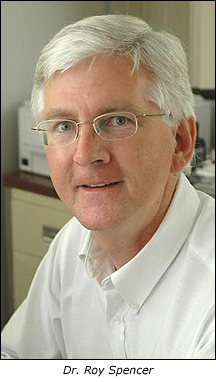
When you're trying your best to comprehend a complicated, abstruse subject, doesn't it make sense to ask a recognized, highly respected expert in the field to explain it? This man is just such an expert – a Ph.D. climatologist named Dr. Roy Spencer. He received his Ph.D. from the University of Wisconsin-Madison in 1981, while the father of climatology, the late Dr. Reid Bryson, was still actively teaching there. Since then, he has earned an enviable reputation as one of the top scientists in his field.

Dr. Spencer has just published an important article on Townhall.com titled Special Report: Global Warming Gloom and Doom Cools Off. It's written for the lay person, so any reasonably intelligent adult should be able to understand it. (If you're reading this blog, you automatically qualify.) I'd recommend it for everyone. It will increase your understanding of the subject, ease any uneasiness or doubt you may harbor, and better equip you to counter the arguments of the True Believers of the Church of Global Warming (whose guru is not even a scientist, but a politician who managed to wash out of both law and divinity schools after earning mediocre grades as an undergraduate student).

For more detailed information on the latest developments in climate science, check out Dr. Spencer's blog, here.

For those who'd like to pursue the subject further, I highly recommend Steve McIntyre's Climate Audit (CAUTION: The math gets kind of heavy), Anthony Watts' Watts Up With That?, and Patrick J. Michaels' World Climate Report.

Before you fall for the Inconvenient Hype, do your own research. Check out some good, reliable sources such as those linked above, absorb the information to the best of your ability, evaluate the qualifications of the people behind the sources, then use your own good common sense to evaluate it and decide whose interpretation of the data is most likely to be correct – the politician's or the scientist's.

Wednesday, April 15, 2009

Global Warming and the Scientific-Political Complex

Yesterday's American Spectator included a must-read article by Angelo Codevilla, "Scientific Pretense vs. Democracy." It has done more than any other single article I have read to explain exactly why the Global Warmists first commenced their scam, and why they have been so successful in persuading so many intelligent people who ought to know better to believe in it.

Codevilla's article does not primarily concern global warming. His subject is far broader, encompassing the mutually corrupting effect of combining politics and science beginning in the early 19th Century and continuing to the present. He writes lucidly, argues cogently, and backs up his assertions with incontrovertible proof.

Codevilla argues that politics and science have formed a symbiotic relationship: politicians borrow the scientists' reputation and credibility to impose their will upon the public by non-democratic means, while scientists use the government's power to gain money ("grants"), position, and prestige for themselves. In the process, there are at least two casualties: scientific truth and individual freedom. He points out that Eisenhower's
oft-cited warning about the dangers of a “military-industrial complex” was part of the address’s larger point: the danger that big government poses to citizenship:

…a government contract becomes virtually a substitute for intellectual curiosity. For every old blackboard there are now hundreds of new electronic computers. The prospect of domination of the nation’s scholars by Federal employment, project allocations, and the power of money is ever present and is gravely to be regarded. Yet, in holding scientific research and discovery in respect, as we should, we must also be alert to the equal and opposite danger that public policy could itself become the captive of a scientific technological elite.

Later, he discusses The Goracle:

Power by Pretense

TESTIFYING TO A JOINT CONGRESSIONAL committee on March 21, 2007, former vice president Al Gore argued for taxing the use of energy based on the combustion of carbon, and for otherwise forcing Americans to emit much less carbon dioxide. Gore wanted to spend a substantial amount of the money thus raised to fund certain business ventures. (Incidentally or not, he himself had a large stake in those ventures.)

But, he argued, his proposal was not political, and debating it was somehow illegitimate, because he was just following “ science,” according to which, if these things were not done, Planet Earth would overheat and suffocate. He said: “The planet has a fever. If your baby has a fever, you go to the doctor. If the doctor says you need to intervene here, you don’t say, ‘Well, I read a science fiction novel that tells me it’s not a problem.’” But Gore’s advocacy of “solutions” for “global warming” was anything but politically neutral acceptance of expertise. As vice president until 2001, and afterward, he had done much to build a veritable industry of scientists and publicists who had spent some $50 billion, mostly in government money, during the previous decade to turn out and publicize “studies” bolstering his party’s efforts to regulate and tax in specific ways. Moreover, he claimed enough scientific knowledge to belittle his opposition for following “science fiction.” But Gore’s work was political, not scientific. Not surprisingly, some of his opponents in Congress and among scientists thought that Gore and his favorite scientists were doing well-paid science fiction.

Who was right? Gore’s opponents, led by Oklahoma senator James Inhofe, argued that the substance of the two main questions, whether the Earth was being warmed by human activities, and what if anything could and should be done about it, should be debated before the grand jury of American citizens. Gore et al. countered that “the debate is over!” and indeed that nonscientific citizens had no legitimate place in the debate. Yet he and like-minded citizens claimed to know enough to declare that it had ended. They also claimed that scientists who disagreed with them, or who merely questioned the validity of the conclusions produced by countless government science commissions to which Gore and his followers had funneled government money, and which they called “mainstream science,” were “deniers”—illegitimate. Equally out of place, they argued, were calls that they submit to tests of their scientific IQ. Whatever else one may call this line of argument, one may not call it scientific. It belongs to the genus “politics.” But, peculiarly, it is politics that aims to take matters out of the realm of politics, where citizens may decide by persuading one another, and places them in a realm where power is exercised by capturing the commanding heights of the Establishment.

If you read nothing else, by all means go read this one all the way through.

Scientific Standards

"By the worldly standards of public life, all scholars in their work are of course oddly virtuous. They do not make wild claims, they do not cheat,they do not try to persuade at any cost, they appeal neither to prejudice nor to authority, they are often frank about their ignorance, their disputes are fairly decorous, they do not confuse what is being argued with race, politics, sex or age, they listen patiently to the young and to the old who both know everything. These are the general virtues of scholarship, and they are peculiarly the virtues of science."

~~~~~ Jacob Bronowski

It has become all too apparent that some scientists no longer
conform to the late Dr. Bronowski's exemplary standards.
More's the pity.

Note to NASA: Fire Dr. James Hansen, now.

Hat tip: Anthony Watts

Monday, April 13, 2009

Common Sense About Nuclear Power

Writing in NRO's Planet Gore, William Tucker brings some solid facts and refreshing common sense to the ongoing national debate about nuclear power. It seems that the Nuclear Regulatory Commission is faced with an imminent decision about whether or not to renew the operating license of New Jersey's Oyster Creek nuclear plant. Says Tucker, Go Ahead, Close Oyster Creek.

Part of his argument involves the "clean energy" alternatives to nuclear touted by the enviro-extremists. Here's a pull quote:
Anti-nuclear activists dream that nuclear and coal can be replaced by wind, solar, and other “renewable” things. That’s because nobody has seen what these plants would look like. A 45-story windmill produces 1 megawatt of electricity. Windmills must be spaced several hundred feet apart so they don’t interfere with each other. To replace Oyster Creek’s 650 megawatts, New Jersey would have to cover 300 square miles of land or ocean with 45-story windmills. Even then, they’d only work when the wind blows, which is about one-third of the time. To replace just one of Indian Point’s reactors, you’d have to cover every square inch of Westchester County or Long Island Sound. Windmills would work blanketing Vermont’s Green Mountains, but then the state could likely kiss its fall-foliage tourism goodbye.

Solar collectors face the same problem. In New York and New England, you could rely on them only for summertime peak loads, since there are too many cloudy days the rest of the year. California had big plans to build 500 MW of solar capacity in the Mojave Desert — until California Senator Diane Feinstein announced two weeks ago she would seek legislation banning solar collectors from the Mojave, with nature groups having suddenly realized what a 25- to 30-square-mile facility would do for the desert environment.

This piece packs a concentrated dose of wisdom into a very small space. By all means read the whole thing.

More on the PUMA

Here's another comment on the PUMA from Sean Delonis of the New York Post:


Hat tip: Greg Pollowitz writing in NRO's Planet Gore

Sunday, November 2, 2008

"Hope and Change" vs. Reality

In his inimitable style, Mark Steyn explains what's at stake on November 4th in Obama in 2-D. Here's an excerpt:
In his Wednesday-night infomercial, Obama declared that his “fundamental belief” was that “I am my brother’s keeper.” Back in Kenya, his brother lives in a shack on 12 bucks a year. If Barack is his brother’s keeper, why couldn’t he send him a ten-dollar bill and near double the guy’s income? The reality is that Barack Obama assumes the government should be his brother’s keeper, and his aunt’s keeper. Why be surprised by that? For 20 years in Illinois, Obama has marinated in the swamps of the Chicago political machine and the campus radicalism of William Ayers and Rashid Khalidi. In such a world, the redistributive urge is more or less a minimum entry qualification.
You'll definitely want to read the rest of it.

It's too bad that those who would benefit most from the wisdom in Mark Steyn's article are least likely to read it. Instead, if they haven't already Early Voted their way to Obamatopia, they'll eagerly go lemming-like to the polls in two days and give away their birthright.

In a just world, only those who are foolish enough to believe in the false comic-book persona sold to them by Obama the Master Con Man and his enablers would pay the price for their gullibility. In the real world, though, that's not the way it works. Should they succeed in elevating their pseudo-messiah to the White House, we're all going to be learning a painful lesson about reality.

For three plausible scenarios of what an Obama administration might look like four years hence, see Jonah Goldberg's OBAMA 2012: FOUR YEARS LATER, Nicole Gelinas' OBAMA 2012: A TERM OF FI$CAL PAIN, and Ralph Peters' OBAMA 2012: HIS TRIUMPHS ABROAD.

Also, if you haven't already done so, check out what Obama had to say in a January 17, 2008 interview with the San Francisco Chronicle that has just come to light. See Coal official calls Obama comments 'unbelievable' in the West Virginia Record and Obama Called Out for Comments about Bankrupting Coal Industry from WSAZ, then listen to the audio for yourself.


Note that in addition to his revealing comments about coal, the source of nearly half of our electricity, he also states that he wants the cost of electricity to skyrocket. Taken together with his stated intention to move us away from gas and diesel and toward electricity to power our vehicles, it would appear that Obama's ultimate aim is to reduce our lifestyle to third-world conditions in some sort of quixotic quest for "fairness."

I wonder what Obama's fans will think of him then. It will be scant comfort to be able to tell them "I told you so!"

Saturday, June 21, 2008

Energy Wisdom from Charles Krauthammer

The brilliant Charles Krauthammer has written a concise essay which John McCain badly needs to read. It's available in several places, including NRO, as "McCain’s Partial Fix", and Townhall.com, as "Critical Thinking on Energy." Here's are two pull quotes:
McCain's problem is that he's only able to go halfway on energy production because he has locked himself into opposition to the other obvious source of domestic oil -- the Arctic National Wildlife Refuge.

His fastidiousness on this is inexplicable. "I believe that ANWR is a pristine area," he explains. Is it more pristine than the ocean, where he now wants to drill? More pristine than the Arabian Desert from which we daily beg the Saudi princes to pump more oil?

**********
McCain's unwillingness to include ANWR lacks even political logic. His policy on offshore drilling is a flip-flop from his past positions. Perfectly justified, but a reconsideration nonetheless. If you are going to take the hit for flip-flopping and for offending environmentalists, why go halfway?

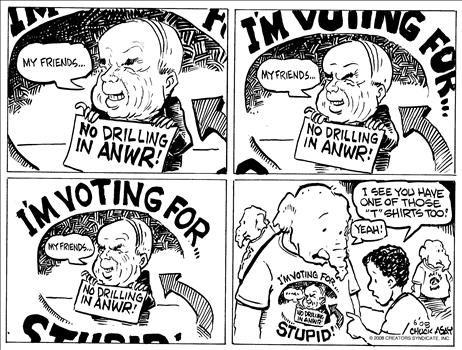
Let's hope that McCain, or those close to him, will read Krauthammer's wise words and take them to heart. Unless and until they do, the situation is, sadly, exactly as described by Chuck Asay in this cartoon:


With all due respect, Senator McCain, WISE UP – WHILE THERE'S STILL TIME!

Hat tip for the cartoon: Townhall.com.

Tuesday, June 17, 2008

We Have Only Ourselves to Blame for $4 Gas

Noel Sheppard, Associate Editor of Newsbusters, has posted an incisive essay on NRO's "Planet Gore" blog, "We Have Only Ourselves to Blame for $4 Gas."

Here's how it starts:
As oil prices head through the roof, and gasoline jumps over $4 a gallon, Americans feeling the pinch at the pump should recognize that the wealthiest nation on the planet has nothing but itself to blame for the third in a series of energy crises that began when Richard Nixon was still in office.

Having largely ignored the previous two shots across the bow — the first coming in 1973 when OPEC decided to ban sales of oil to nations that supported Israel in the Yom Kippur War, and the second in 1979 after the Islamic Revolution in Iran — the U.S. seems determined to repeat the mistakes of the past.

We keep hearing about the worldwide decline in oil production, and tend to assume that the situation in the rest of the world mirrors our own. Sheppard points out that this assumption is false:
At least those countries are participating in exploration efforts to expand their own supplies. China’s oil production has almost doubled since 1980, while India’s has grown by an astounding 375 percent. At the same time, U.S. production has declined by 22 percent.

We sure do know how to respond to energy crises in this country, don’t we?

Closer to home, our neighbors also ramped up oil production. To the south, Mexico has seen its crude output jump 64 percent since 1980, while Canada’s increased 85 percent.

Did you know that? I must confess that I did not.

After explaining in simple, understandable language how the oil futures market works and what effects we could expect to be exerted upon it simply as a result of making the policy changes necessary to facilitate future increased oil production, Sheppard asks these questions:
Why has one political party for nearly four decades viewed energy crises through the narrow prism of learning to adjust to higher prices and declining resources, as opposed to aggressively finding and producing more of what the country and the economy needs?

Such questions seem particularly relevant given how this same party views hunger in our nation and throughout the world. The answer isn’t for those that have less to make an adjustment and adapt to their impoverished condition. “Adjust to having less” is certainly not the Left’s prescription for Americans lacking health insurance.

Democrats want government to increase the supply of food and medical care to those deemed financially incapable of providing for themselves.

Why doesn’t the same hold true for energy? Does the Left just presume that food and medicine are both human necessities government is required to assist the citizenry in obtaining, while energy is a luxury item people can learn to do without?

It's hard to argue with Sheppard's conclusions. Now, our task – and it is a formidable one – is to exert sufficient pressure upon our elected representatives to induce them to follow our wishes instead of the desires of their friends the environmental zealots.

Another Bullseye from Lisa Benson

I'm becoming a huge Lisa Benson fan. Besides being a superb cartoonist, she obviously has a comprehensive understanding of the issues. Check out her latest effort and see if you don't agree.


Hat tip: Jewish World Review

Saturday, June 14, 2008

Thought for Today

They say oil causes pollution. A hundred years ago the streets were ankle deep in horse excrement. What kind of pollution do you want, anyway? Would you rather die of cancer at eighty, or die of typhoid fever at nine?

~~~~~ P.J. O'Rourke