"When anyone asks me how I can best describe my experience in nearly forty years at sea, I merely say, uneventful. Of course there have been winter gales, and storms and fog and the like. But in all my experience, I have never been in any accident...of any sort worth speaking about. I have seen but one vessel in distress in all my years at sea. I never saw a wreck and never have been wrecked nor was I ever in any predicament that threatened to end in disaster of any sort."
~~~~~ E. J. Smith, 1907
(Captain, RMS Titanic)
Showing posts with label Merchant Marine. Show all posts
Showing posts with label Merchant Marine. Show all posts
Tuesday, December 22, 2009
Thought for Today


Tuesday, April 21, 2009
Suspicions Confirmed
Last week, I raised the question of why the crew of the BAINBRIDGE had made no attempt to aid Capt. Phillips when he jumped into the water and attempted to escape from the pirates. I suspected that the reason was that they had been ordered not to, and therefore had no choice but to stand by helplessly as the pirates dragged the captain back aboard the lifeboat.
A few minutes ago on the O'Reilly Factor, Col. David Hunt, Fox military analyst and author of On the Hunt , confirmed my suspicions. According to Col. Hunt, even before the SEALs arrived on board, the BAINBRIDGE was fully capable of neutralizing the pirates and rescuing Capt. Phillips had they been authorized to do so. But at the time, they were operating under strict Rules of Engagement which prohibited them from firing a shot without obtaining prior authorization through the chain of command. Furthermore, that chain was far too long and cumbersome, stretching all the way from the Commander-in-Chief through a whole string of commands before it reached the skipper of the BAINBRIDGE. In fact, had he been authorized from the beginning to use his best professional judgment and take whatever action he deemed appropriate, the captain of the BAINBRIDGE, Cdr. Frank Castellano, could have brought the incident to a successful conclusion shortly after his arrival on the scene, instead of having to leave Capt. Phillips bobbing around on that lifeboat for 4 days.
Can you imagine how Capt. Phillips must have felt after he risked his life by jumping into shark-infested waters at night in order to give the BAINBRIDGE a clear shot – and nothing happened? It's very fortunate that he's such a level-headed, focused, strong-willed man that he was able to take such a bitter disappointment in stride, then plan for his next opportunity.
Noteworthy, too, is the fact that when Capt. Phillips arrived back in the United States and made a few public remarks, although he had the highest praise for the US military, and in particular, the Navy, the BAINBRIDGE, and the SEALs, there was not one word about our inexperienced young president – who is obviously still undergoing his on-the-job training.
UPDATE 4/23/09 1:39 AM: In EXCLUSIVE: Obama OK'd 2 SEAL teams for pirates, the Washington Times reports that National Security Adviser James L. Jones claims that the above account is false:
So the question becomes one of who do you believe, or "he said; he said."
To the best of my knowledge, both Gen. Jones and Col. Hunt have a reputation for honesty and frankness.
Gen. Jones is certainly in the best position to know what actually happened, but on the other hand is far from impartial. Because of his present position as Obama's National Security Adviser, he has a vested interest in vouching for the official version of events. Under the circumstances, he could hardly be expected to contradict it unless he were to simultaneously tender his resignation.
On the other hand, Col. Hunt's knowledge of the details of the operation comes to him second- or third-hand, since he was not personally involved in it. In stating his version of events during Bill O'Reilly's program, though, he spoke with great certainty, as though he had great confidence in his sources. In addition, since he had no personal involvement or vested interest, he would be more likely to be impartial.
There were a large number of military personnel involved in the operation, including the entire crew of the USS BAINBRIDGE. Chances are that during the next few months and years, a true account of what actually happened will gradually take form. Particularly as the members of the BAINBRIDGE's crew return to civilian life one by one, there will be no way that the Navy could possibly keep them from telling what they know. For now, though, we must content ourselves with this contradiction.
Although I have no firm justification for doing so, I am more inclined to believe Col. Hunt's account – primarily because during the years I have been watching him on Fox News, he has always proven to know what he's talking about, but also because he is free to speak his mind. On the other hand, while I respect Gen. Jones for his long and distinguished service in the Marine Corps, his post-retirement activities have been problematic. For one thing, he has a reputation as an Israel-basher and Saudi sympathizer – which, in my opinion, immediately calls his judgment into question. Then, of course, there's the matter of his position as a cabinet-level adviser to the PITOTUS. If he wants to keep it, he must pretty well toe the official line – which includes doing everything in his power to make his inexperienced, gaffe-prone boss look good.
Finally, there is the undeniable fact that already, during the three months it has been in office, this administration has earned a reputation for issuing misleading, contradictory, and downright duplicitous statements. The PITOTUS has shown a propensity to say one thing while brazenly doing the exact opposite, so why would we expect his senior staff to act differently from their boss?
A few minutes ago on the O'Reilly Factor, Col. David Hunt, Fox military analyst and author of On the Hunt
, confirmed my suspicions. According to Col. Hunt, even before the SEALs arrived on board, the BAINBRIDGE was fully capable of neutralizing the pirates and rescuing Capt. Phillips had they been authorized to do so. But at the time, they were operating under strict Rules of Engagement which prohibited them from firing a shot without obtaining prior authorization through the chain of command. Furthermore, that chain was far too long and cumbersome, stretching all the way from the Commander-in-Chief through a whole string of commands before it reached the skipper of the BAINBRIDGE. In fact, had he been authorized from the beginning to use his best professional judgment and take whatever action he deemed appropriate, the captain of the BAINBRIDGE, Cdr. Frank Castellano, could have brought the incident to a successful conclusion shortly after his arrival on the scene, instead of having to leave Capt. Phillips bobbing around on that lifeboat for 4 days.Can you imagine how Capt. Phillips must have felt after he risked his life by jumping into shark-infested waters at night in order to give the BAINBRIDGE a clear shot – and nothing happened? It's very fortunate that he's such a level-headed, focused, strong-willed man that he was able to take such a bitter disappointment in stride, then plan for his next opportunity.
Noteworthy, too, is the fact that when Capt. Phillips arrived back in the United States and made a few public remarks, although he had the highest praise for the US military, and in particular, the Navy, the BAINBRIDGE, and the SEALs, there was not one word about our inexperienced young president – who is obviously still undergoing his on-the-job training.
UPDATE 4/23/09 1:39 AM: In EXCLUSIVE: Obama OK'd 2 SEAL teams for pirates, the Washington Times reports that National Security Adviser James L. Jones claims that the above account is false:
EXCLUSIVE:
President Obama dispatched two separate teams of Navy commandos to carry out last week's rescue of a merchant ship captain held hostage by Somali pirates but left the operational details and rules of engagement to military commanders, National Security Adviser James. L. Jones said Tuesday.
"I can tell you from a White House and presidential standpoint, there was no conflict, no gnashing of teeth, or excessive influence in trying to manage this thing," Mr. Jones, a retired Marine Corps four-star general, told The Washington Times in an interview.
He and other military officials gave the most detailed account to date of how Navy SEAL forces were dispatched - first from a base in Africa and later from the United States - to carry out the mission, and how Pentagon officials communicated with the White House. They sought to dispel Internet reports that the military was delayed from taking action by indecision inside the White House.
"I don't recognize" the information being circulated on the Internet, Mr. Jones said.
So the question becomes one of who do you believe, or "he said; he said."
To the best of my knowledge, both Gen. Jones and Col. Hunt have a reputation for honesty and frankness.
Gen. Jones is certainly in the best position to know what actually happened, but on the other hand is far from impartial. Because of his present position as Obama's National Security Adviser, he has a vested interest in vouching for the official version of events. Under the circumstances, he could hardly be expected to contradict it unless he were to simultaneously tender his resignation.
On the other hand, Col. Hunt's knowledge of the details of the operation comes to him second- or third-hand, since he was not personally involved in it. In stating his version of events during Bill O'Reilly's program, though, he spoke with great certainty, as though he had great confidence in his sources. In addition, since he had no personal involvement or vested interest, he would be more likely to be impartial.
There were a large number of military personnel involved in the operation, including the entire crew of the USS BAINBRIDGE. Chances are that during the next few months and years, a true account of what actually happened will gradually take form. Particularly as the members of the BAINBRIDGE's crew return to civilian life one by one, there will be no way that the Navy could possibly keep them from telling what they know. For now, though, we must content ourselves with this contradiction.
Although I have no firm justification for doing so, I am more inclined to believe Col. Hunt's account – primarily because during the years I have been watching him on Fox News, he has always proven to know what he's talking about, but also because he is free to speak his mind. On the other hand, while I respect Gen. Jones for his long and distinguished service in the Marine Corps, his post-retirement activities have been problematic. For one thing, he has a reputation as an Israel-basher and Saudi sympathizer – which, in my opinion, immediately calls his judgment into question. Then, of course, there's the matter of his position as a cabinet-level adviser to the PITOTUS. If he wants to keep it, he must pretty well toe the official line – which includes doing everything in his power to make his inexperienced, gaffe-prone boss look good.
Finally, there is the undeniable fact that already, during the three months it has been in office, this administration has earned a reputation for issuing misleading, contradictory, and downright duplicitous statements. The PITOTUS has shown a propensity to say one thing while brazenly doing the exact opposite, so why would we expect his senior staff to act differently from their boss?
Wednesday, April 15, 2009
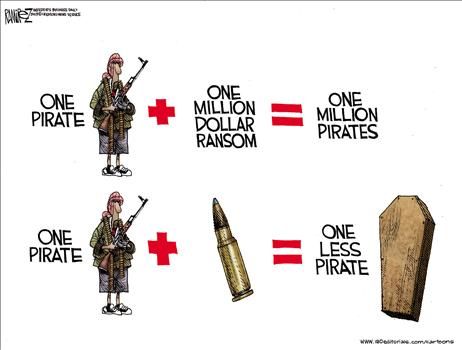

Tuesday, April 14, 2009
Piracy: The Family Business?
Travis Kavulla, a journalist and scholar with an intimate knowledge of African history, disagrees with the prevailing opinion that Somalian piracy is the result of anarchy. Instead, he posits, it is, in effect, a family business, run as a profit-making enterprise by surprisingly well-organized Somali clans. His post to NRO's The Corner, "Piracy: The Family Business?" expounds upon his theory:
I think he makes a great deal of sense. Read it and see if you agree.
Clan’s usefulness became obvious to me last November, when I went to Mombasa, Kenya’s coastal port city, to attend the trial of eight Somali pirates who had been dumped there by the U.S. navy for prosecution. Sitting in the courtroom, waiting for the pirates to be brought forward, I watched as Kenyan after Kenyan was called to the dock to have read charges against him. Each defendant, whether on trial for murder or armed assault or simple theft, lacked defense counsel. Then came the Somalis and, as their case number was read, a figure in black robe and white wig leapt forward: the pirates’ attorney, one of Mombasa’s best, who later told me he was being paid from a Dubai account to the tune of thousands of dollars. Clan had come through for these pirates.Kavulla believes that our response to the Maersk Alabama hijacking was exactly right, while the feckless response of most European nations exacerbates the problem.
I think he makes a great deal of sense. Read it and see if you agree.
Monday, April 13, 2009
Just Wondering ...
By now, everyone knows that the hostage situation off the coast of Somalia has ended well. Capt. Richard Phillips is safe, and will shortly be rejoining his family. On the other hand, three of the pirates have not fared too well after experiencing first-hand the effects of a perfectly aimed high velocity projectile when it enters the human skull. Presumably, being adherents of the ROP, they have already joined their promised 72 virgins. Their diminutive 16-year-old colleague, having had the good sense to inveigle his way aboard the USS BAINBRIDGE to "negotiate," is still alive, in reasonably good health, in custody, undoubtedly enjoying the best food and most comfortable quarters he has ever experienced – and is looking forward to an involuntary trip to New York and a lengthy prison sentence.
All in all, a nice day's work for the U.S. Navy, and in particular for the incomparable SEALs and the captain and crew of the BAINBRIDGE. Capt. Phillips deserves a tremendous amount of credit for his own survival, too. He kept his wits about him under the most trying circumstances imaginable, and managed to maneuver his captors into an untenable situation from which they had no realistic possibility of escape. Finally, credit where credit is due: overall, President Obama handled this situation just about perfectly. Bravo Zulu to all! (That's Navy-ese for "Well Done.")
Nevertheless, I'm just wondering about one thing. When Capt. Phillips attempted to escape from his captors by jumping out of the lifeboat and trying to swim to the nearby USS BAINBRIDGE, apparently no one aboard the destroyer made any attempt to help him. Consider: Capt. Phillips is a 53-year-old man – obviously a man in excellent physical condition, but nevertheless 53 years old &ndash yet he intentionally leaped into shark-infested waters at night. Isn't it likely that he fully expected the crew of the BAINBRIDGE to come to his aid? I'm sure that they wanted to help him – so why didn't they?
As a former U.S. Navy officer, I can think of only two possibilities. Either there was some other factor of which we are not aware which precluded any assistance from the BAINBRIDGE, or – far more likely, I'm afraid – the captain of the BAINBRIDGE was operating under rules of engagement that prohibited him from using force without direct presidential authorization.
In due course, and following not one, but two requests from the Defense Department, the captain of the BAINBRIDGE was finally authorized to do what needed to be done. As soon as the opportunity presented itself, he did it – flawlessly.
But what took so long? Considering the nature of his assignment, why was the captain of the BAINBRIDGE not authorized from the beginning to use his own judgment? And why did the Secretary of Defense have to ask the President twice to grant permission?
As I said, just wondering ...
UPDATE: Over at Pajamas Media, Jeff Emanuel, a military veteran with actual experience as a Special Forces soldier, has also been wondering: The Story of a Successful Rescue (and the Obama Adminstration’s Attempt to Claim Credit). He mistakenly refers to "the small inflatable lifeboat" (it was a 28-foot rigid fiberglass-hulled pod-type craft with a diesel engine), but aside from that minor detail, he's right on the money when he states:
It'll be worth your time to click the link and read the rest of Jeff's piece. When it comes to Special Ops, he knows what he's talking about – a claim I certainly cannot make. (My three years' experience as a Navy officer was spent aboard a geological survey ship which never fired a shot in anger during my entire tour of duty.)
UPDATE II: Take a look at How the rescue happened by retired Special Forces Master Sergeant Uncle Jimbo, writing at the superb milblog Blackfive. Be sure to read the comments, too – particularly those from Major Kong. Here's a small sample:
UPDATE III:
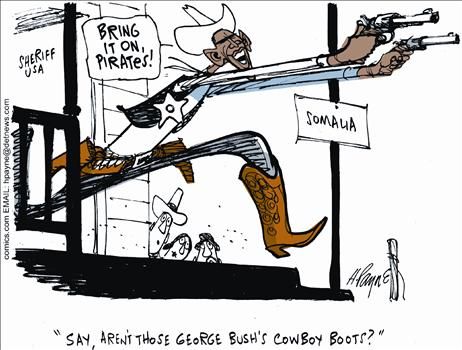
Hat tip: Henry Payne and Townhall.com
All in all, a nice day's work for the U.S. Navy, and in particular for the incomparable SEALs and the captain and crew of the BAINBRIDGE. Capt. Phillips deserves a tremendous amount of credit for his own survival, too. He kept his wits about him under the most trying circumstances imaginable, and managed to maneuver his captors into an untenable situation from which they had no realistic possibility of escape. Finally, credit where credit is due: overall, President Obama handled this situation just about perfectly. Bravo Zulu to all! (That's Navy-ese for "Well Done.")
Nevertheless, I'm just wondering about one thing. When Capt. Phillips attempted to escape from his captors by jumping out of the lifeboat and trying to swim to the nearby USS BAINBRIDGE, apparently no one aboard the destroyer made any attempt to help him. Consider: Capt. Phillips is a 53-year-old man – obviously a man in excellent physical condition, but nevertheless 53 years old &ndash yet he intentionally leaped into shark-infested waters at night. Isn't it likely that he fully expected the crew of the BAINBRIDGE to come to his aid? I'm sure that they wanted to help him – so why didn't they?
As a former U.S. Navy officer, I can think of only two possibilities. Either there was some other factor of which we are not aware which precluded any assistance from the BAINBRIDGE, or – far more likely, I'm afraid – the captain of the BAINBRIDGE was operating under rules of engagement that prohibited him from using force without direct presidential authorization.
In due course, and following not one, but two requests from the Defense Department, the captain of the BAINBRIDGE was finally authorized to do what needed to be done. As soon as the opportunity presented itself, he did it – flawlessly.
But what took so long? Considering the nature of his assignment, why was the captain of the BAINBRIDGE not authorized from the beginning to use his own judgment? And why did the Secretary of Defense have to ask the President twice to grant permission?
As I said, just wondering ...
UPDATE: Over at Pajamas Media, Jeff Emanuel, a military veteran with actual experience as a Special Forces soldier, has also been wondering: The Story of a Successful Rescue (and the Obama Adminstration’s Attempt to Claim Credit). He mistakenly refers to "the small inflatable lifeboat" (it was a 28-foot rigid fiberglass-hulled pod-type craft with a diesel engine), but aside from that minor detail, he's right on the money when he states:
What should have been a standoff lasting only hours — as long as it took the USS Bainbridge and its team of NSWC operators to steam to the location — became an embarrassing four-day-and-counting standoff between a rag-tag handful of criminals with rifles and a U.S. Navy warship.
It'll be worth your time to click the link and read the rest of Jeff's piece. When it comes to Special Ops, he knows what he's talking about – a claim I certainly cannot make. (My three years' experience as a Navy officer was spent aboard a geological survey ship which never fired a shot in anger during my entire tour of duty.)
UPDATE II: Take a look at How the rescue happened by retired Special Forces Master Sergeant Uncle Jimbo, writing at the superb milblog Blackfive. Be sure to read the comments, too – particularly those from Major Kong. Here's a small sample:
Now, how do we deal with the problem of piracy on the Horn of Africa on the larger, long-term, strategic level? Here are my ideas (nothing particularly original here):Great stuff!
1. Arm the merchant ships. If the shipping companies don't want to arm the crews for liability reasons, then hire professional security companies to provide armed escorts while transiting that particular region. Blackwater (or Xe, or whatever they're calling themselves these days) sounds like a perfect fit for this mission, given their roots in the Naval Special Warfare community, and they're probably looking for a few new gigs after losing their biggest contract in Iraq.
2. Utilize "Q-Ship" operations. That is, outfit a number of vessels to look like harmless, helpless merchant ships. Have them ply up and down the East Coast of Africa, making port calls in Mombassa, etc., where the crews disembark and drink it up at the local bars, telling everyone about the fantastically valuable cargoes they are carrying. In fact, of course, the ships are full of special ops-types in full kit, with camouflaged heavy weapons like M2s, Mk-19s, and Barrett .50s. When pirates attempt to assault the Q-Ships, smoke them like beef jerky. Wash, rinse, repeat...
UPDATE III:
Hat tip: Henry Payne and Townhall.com
Tuesday, June 10, 2008
Uncommon Valor – A Forgotten Story
Hal G. P. Colebatch, an Australian lawyer and author, has uncovered a remarkable story of American valor against insurmountable odds during the darkest days of World War II. You can read about it here "Stephen Hopkins vs. the Germans," in today's version of The American Spectator.
As Colebatch succinctly states,
As Colebatch succinctly states,
This is the story of a forgotten ship with a prosaic name. But when I came across it accidentally in the course of some other research I thought it a story that it would be good for America to be reminded of. And, possibly, good for America's enemies to be reminded of, too.By all means, go read this amazing story. If nothing else, it will place our present difficulties, minor by comparison, into proper perspective, and renew either your pride in being an American, or your envy of those of us who are fortunate enough to be citizens of the greatest nation in the world.
Subscribe to:
Posts (Atom)