Showing posts with label Navy. Show all posts

Saturday, April 25, 2015

Not Under Command

If the United States were a ship, it would be displaying its "Not under command" signal -- two red balls (by day) or lights (by night) in a vertical line indicating that the ship cannot control its movements because of problems with its steering gear or propulsion system. Other vessels who observe the signal know that they must take action to stay out of the ship's way because it is incapable of fulfilling its obligations under the International Rules of the Road.


During my Navy days, in order to remember the meaning of three similar signals, white over red (a pilot boat on station), red over white (a fishing boat engaged in fishing), and the aforementioned red over red, we used this mnemonic: 

"White over red: Pilot ahead; 
Red over white: Fishing at night; 
Red over red: Captain is dead."


Saturday, May 23, 2009

Don Feder: An American Credo

Don Feder has written an outstanding Memorial Day column, An American Credo. Here's how it begins:
On the day when we memorialize those who gave their lives so America would endure, we should ask what it means to be a citizen of this republic. Here are the thoughts of one American, a credo for the coming millennia.

I am an American. I was conceived at Plymouth, born in Lexington and Concord, and reached maturity at Philadelphia.

I went through the fires of Shiloh, Gualdacanal, the Chosin Resovoir, Khe Sanh and a thousand other battlefields, and emerged rededicated to the ideals on which America was founded.

I am an American. Ever ready to defend my liberty and independence, to make any sacrifice and bear any burden – still, I seek no quarrel.

To read the rest of this stirring tribute to American exceptionalism, click here.

Hat tip: Jewish World Review

Tuesday, April 21, 2009

Suspicions Confirmed

Last week, I raised the question of why the crew of the BAINBRIDGE had made no attempt to aid Capt. Phillips when he jumped into the water and attempted to escape from the pirates. I suspected that the reason was that they had been ordered not to, and therefore had no choice but to stand by helplessly as the pirates dragged the captain back aboard the lifeboat.

A few minutes ago on the O'Reilly Factor, Col. David Hunt, Fox military analyst and author of On the Hunt, confirmed my suspicions. According to Col. Hunt, even before the SEALs arrived on board, the BAINBRIDGE was fully capable of neutralizing the pirates and rescuing Capt. Phillips had they been authorized to do so. But at the time, they were operating under strict Rules of Engagement which prohibited them from firing a shot without obtaining prior authorization through the chain of command. Furthermore, that chain was far too long and cumbersome, stretching all the way from the Commander-in-Chief through a whole string of commands before it reached the skipper of the BAINBRIDGE. In fact, had he been authorized from the beginning to use his best professional judgment and take whatever action he deemed appropriate, the captain of the BAINBRIDGE, Cdr. Frank Castellano, could have brought the incident to a successful conclusion shortly after his arrival on the scene, instead of having to leave Capt. Phillips bobbing around on that lifeboat for 4 days.

Can you imagine how Capt. Phillips must have felt after he risked his life by jumping into shark-infested waters at night in order to give the BAINBRIDGE a clear shot – and nothing happened? It's very fortunate that he's such a level-headed, focused, strong-willed man that he was able to take such a bitter disappointment in stride, then plan for his next opportunity.

Noteworthy, too, is the fact that when Capt. Phillips arrived back in the United States and made a few public remarks, although he had the highest praise for the US military, and in particular, the Navy, the BAINBRIDGE, and the SEALs, there was not one word about our inexperienced young president – who is obviously still undergoing his on-the-job training.

UPDATE 4/23/09 1:39 AM: In EXCLUSIVE: Obama OK'd 2 SEAL teams for pirates, the Washington Times reports that National Security Adviser James L. Jones claims that the above account is false:
EXCLUSIVE:

President Obama dispatched two separate teams of Navy commandos to carry out last week's rescue of a merchant ship captain held hostage by Somali pirates but left the operational details and rules of engagement to military commanders, National Security Adviser James. L. Jones said Tuesday.

"I can tell you from a White House and presidential standpoint, there was no conflict, no gnashing of teeth, or excessive influence in trying to manage this thing," Mr. Jones, a retired Marine Corps four-star general, told The Washington Times in an interview.

He and other military officials gave the most detailed account to date of how Navy SEAL forces were dispatched - first from a base in Africa and later from the United States - to carry out the mission, and how Pentagon officials communicated with the White House. They sought to dispel Internet reports that the military was delayed from taking action by indecision inside the White House.

"I don't recognize" the information being circulated on the Internet, Mr. Jones said.

So the question becomes one of who do you believe, or "he said; he said."

To the best of my knowledge, both Gen. Jones and Col. Hunt have a reputation for honesty and frankness.

Gen. Jones is certainly in the best position to know what actually happened, but on the other hand is far from impartial. Because of his present position as Obama's National Security Adviser, he has a vested interest in vouching for the official version of events. Under the circumstances, he could hardly be expected to contradict it unless he were to simultaneously tender his resignation.

On the other hand, Col. Hunt's knowledge of the details of the operation comes to him second- or third-hand, since he was not personally involved in it. In stating his version of events during Bill O'Reilly's program, though, he spoke with great certainty, as though he had great confidence in his sources. In addition, since he had no personal involvement or vested interest, he would be more likely to be impartial.

There were a large number of military personnel involved in the operation, including the entire crew of the USS BAINBRIDGE. Chances are that during the next few months and years, a true account of what actually happened will gradually take form. Particularly as the members of the BAINBRIDGE's crew return to civilian life one by one, there will be no way that the Navy could possibly keep them from telling what they know. For now, though, we must content ourselves with this contradiction.

Although I have no firm justification for doing so, I am more inclined to believe Col. Hunt's account – primarily because during the years I have been watching him on Fox News, he has always proven to know what he's talking about, but also because he is free to speak his mind. On the other hand, while I respect Gen. Jones for his long and distinguished service in the Marine Corps, his post-retirement activities have been problematic. For one thing, he has a reputation as an Israel-basher and Saudi sympathizer – which, in my opinion, immediately calls his judgment into question. Then, of course, there's the matter of his position as a cabinet-level adviser to the PITOTUS. If he wants to keep it, he must pretty well toe the official line – which includes doing everything in his power to make his inexperienced, gaffe-prone boss look good.

Finally, there is the undeniable fact that already, during the three months it has been in office, this administration has earned a reputation for issuing misleading, contradictory, and downright duplicitous statements. The PITOTUS has shown a propensity to say one thing while brazenly doing the exact opposite, so why would we expect his senior staff to act differently from their boss?

Monday, April 20, 2009

Thomas Paine and Me, or It's a Small World

By now, you've probably seen the Thomas Paine re-enactor whose videos have become some of the most popular on YouTube. He's also been featured – and interviewed – on Fox News, which is where I first saw him.

When I first saw the man in his Tom Paine character, of course I was quite impressed, but I honestly can't say I recognized him. But his voice sounded vaguely familiar.

When he was interviewed on Fox News, I learned that his real name is Bob Basso – and I thought, "Surely not!" You see, a long time ago, I had the great honor and privilege of serving as an officer aboard a ship of the U.S. Navy, the USS MAURY (AGS-16), a geological survey ship. One of my fellow officers was one LTJG Robert L. Basso.

I studied the videos on YouTube and the picture in my copy of the USS MAURY's 1963-64 cruisebook. While there was certainly a resemblance, I couldn't be sure. So I found Thomas Paine re-enactor Bob Basso's website and used it to contact him with this simple message:
Was wondering if by any chance you're the same Bob Basso with whom I served aboard the USS MAURY during the 1963-64 cruise.

5 days later (Bob's understandably pretty busy these days), he replied with the news that indeed he was the very same Bob Basso with whom I served 46 years ago.

Here are then-and-now pictures of LTJG Robert L. Basso:

Here are the links to all three of Bob's videos:
The Second American Revolution
We the People Stimulus Package
Thomas Paine On to Washington


And just to be fair about all this, here are then-and-now pictures of your humble correspondent, who was then known as LTJG Morton A. Goldberg:

It's a small world, isn't it?

Friday, April 17, 2009

Col. Peters Is Furious ...

… and as a fellow military veteran, I can appreciate why. In response to the calculated and deliberate smear of veterans by our esteemed (NOT!) Director of Homeland Security, he wrote The Vet 'Threat': Gov't ID's Public Enemy No. 1. He begins like this:
HOLLYWOOD and countless professors warned us: Military vets are drooling trailer-trash who beat their wives and, at best, wind up as homeless street people -- at worst, as homicidal psychos deformed by war.

Now, thanks to our ever-vigilant Department of Homeland Security, the full extent of the danger has been revealed: Our so-called "war heroes" are rushing back to join right-wing-extremist hate groups to overthrow our government.

Let's not quibble about little things like evidence. The Obama administration just knows that vets are all racist, Jew-hating crazies waiting to explode. Thank God, DHS has a fearless leader, Janet-from-another-planet Napolitano, who isn't afraid to call white trash "white trash."
He then proceeds to let everyone know what he REALLY thinks.

I wonder how much Col. Peters' column had to do with Secretary Napolitano's subsequent lame, half-hearted attempts to extinguish the raging inferno of public outrage she had ignited.

Come to think of it, I also wonder if Janet Napolitano has any idea how utterly ridiculous she looks.

Hat tip: Lisa Benson and Townhall.com

Hat tip: Jerry Holbert and Townhall.com

Tuesday, April 14, 2009

Piracy: The Family Business?

Travis Kavulla, a journalist and scholar with an intimate knowledge of African history, disagrees with the prevailing opinion that Somalian piracy is the result of anarchy. Instead, he posits, it is, in effect, a family business, run as a profit-making enterprise by surprisingly well-organized Somali clans. His post to NRO's The Corner, "Piracy: The Family Business?" expounds upon his theory:
Clan’s usefulness became obvious to me last November, when I went to Mombasa, Kenya’s coastal port city, to attend the trial of eight Somali pirates who had been dumped there by the U.S. navy for prosecution. Sitting in the courtroom, waiting for the pirates to be brought forward, I watched as Kenyan after Kenyan was called to the dock to have read charges against him. Each defendant, whether on trial for murder or armed assault or simple theft, lacked defense counsel. Then came the Somalis and, as their case number was read, a figure in black robe and white wig leapt forward: the pirates’ attorney, one of Mombasa’s best, who later told me he was being paid from a Dubai account to the tune of thousands of dollars. Clan had come through for these pirates.
Kavulla believes that our response to the Maersk Alabama hijacking was exactly right, while the feckless response of most European nations exacerbates the problem.

I think he makes a great deal of sense. Read it and see if you agree.

Monday, April 13, 2009

Just Wondering ...

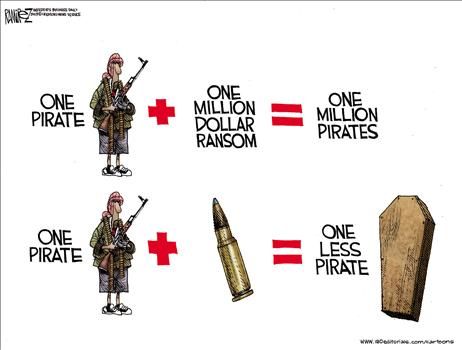
By now, everyone knows that the hostage situation off the coast of Somalia has ended well. Capt. Richard Phillips is safe, and will shortly be rejoining his family. On the other hand, three of the pirates have not fared too well after experiencing first-hand the effects of a perfectly aimed high velocity projectile when it enters the human skull. Presumably, being adherents of the ROP, they have already joined their promised 72 virgins. Their diminutive 16-year-old colleague, having had the good sense to inveigle his way aboard the USS BAINBRIDGE to "negotiate," is still alive, in reasonably good health, in custody, undoubtedly enjoying the best food and most comfortable quarters he has ever experienced – and is looking forward to an involuntary trip to New York and a lengthy prison sentence.

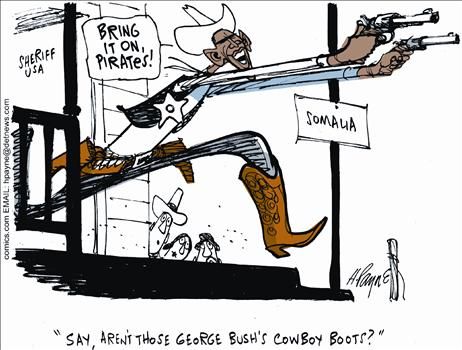
All in all, a nice day's work for the U.S. Navy, and in particular for the incomparable SEALs and the captain and crew of the BAINBRIDGE. Capt. Phillips deserves a tremendous amount of credit for his own survival, too. He kept his wits about him under the most trying circumstances imaginable, and managed to maneuver his captors into an untenable situation from which they had no realistic possibility of escape. Finally, credit where credit is due: overall, President Obama handled this situation just about perfectly. Bravo Zulu to all! (That's Navy-ese for "Well Done.")

Nevertheless, I'm just wondering about one thing. When Capt. Phillips attempted to escape from his captors by jumping out of the lifeboat and trying to swim to the nearby USS BAINBRIDGE, apparently no one aboard the destroyer made any attempt to help him. Consider: Capt. Phillips is a 53-year-old man – obviously a man in excellent physical condition, but nevertheless 53 years old &ndash yet he intentionally leaped into shark-infested waters at night. Isn't it likely that he fully expected the crew of the BAINBRIDGE to come to his aid? I'm sure that they wanted to help him – so why didn't they?

As a former U.S. Navy officer, I can think of only two possibilities. Either there was some other factor of which we are not aware which precluded any assistance from the BAINBRIDGE, or – far more likely, I'm afraid – the captain of the BAINBRIDGE was operating under rules of engagement that prohibited him from using force without direct presidential authorization.

In due course, and following not one, but two requests from the Defense Department, the captain of the BAINBRIDGE was finally authorized to do what needed to be done. As soon as the opportunity presented itself, he did it – flawlessly.

But what took so long? Considering the nature of his assignment, why was the captain of the BAINBRIDGE not authorized from the beginning to use his own judgment? And why did the Secretary of Defense have to ask the President twice to grant permission?

As I said, just wondering ...

UPDATE: Over at Pajamas Media, Jeff Emanuel, a military veteran with actual experience as a Special Forces soldier, has also been wondering: The Story of a Successful Rescue (and the Obama Adminstration’s Attempt to Claim Credit). He mistakenly refers to "the small inflatable lifeboat" (it was a 28-foot rigid fiberglass-hulled pod-type craft with a diesel engine), but aside from that minor detail, he's right on the money when he states:
What should have been a standoff lasting only hours — as long as it took the USS Bainbridge and its team of NSWC operators to steam to the location — became an embarrassing four-day-and-counting standoff between a rag-tag handful of criminals with rifles and a U.S. Navy warship.

It'll be worth your time to click the link and read the rest of Jeff's piece. When it comes to Special Ops, he knows what he's talking about – a claim I certainly cannot make. (My three years' experience as a Navy officer was spent aboard a geological survey ship which never fired a shot in anger during my entire tour of duty.)

UPDATE II: Take a look at How the rescue happened by retired Special Forces Master Sergeant Uncle Jimbo, writing at the superb milblog Blackfive. Be sure to read the comments, too – particularly those from Major Kong. Here's a small sample:
Now, how do we deal with the problem of piracy on the Horn of Africa on the larger, long-term, strategic level? Here are my ideas (nothing particularly original here):

1. Arm the merchant ships. If the shipping companies don't want to arm the crews for liability reasons, then hire professional security companies to provide armed escorts while transiting that particular region. Blackwater (or Xe, or whatever they're calling themselves these days) sounds like a perfect fit for this mission, given their roots in the Naval Special Warfare community, and they're probably looking for a few new gigs after losing their biggest contract in Iraq.

2. Utilize "Q-Ship" operations. That is, outfit a number of vessels to look like harmless, helpless merchant ships. Have them ply up and down the East Coast of Africa, making port calls in Mombassa, etc., where the crews disembark and drink it up at the local bars, telling everyone about the fantastically valuable cargoes they are carrying. In fact, of course, the ships are full of special ops-types in full kit, with camouflaged heavy weapons like M2s, Mk-19s, and Barrett .50s. When pirates attempt to assault the Q-Ships, smoke them like beef jerky. Wash, rinse, repeat...
Great stuff!

UPDATE III:


Hat tip: Henry Payne and Townhall.com

Saturday, October 11, 2008

Another Question from Hannah

Once again, Hannah, my 17-year-old granddaughter, asked me a very good question:
"Can you tell me what is wrong with Obama and his policies?"

Of course, those of us who follow current affairs know the answer already. Unfortunately, there are millions of people out there, many of whom will be voting on November 4th, who have no idea why we find the prospect of an Obama presidency so disturbing. Like my granddaughter (who won't be quite old enough to vote this time around), they have only the vaguest idea of what the two candidates stand for, and the significant differences between them.

Here's what I told Hannah:

Yes. He's a radical leftist who wants to turn the country away from capitalism and toward a system of European socialism in which an all-wise, all-powerful government directs private companies how to run their businesses, and private citizens how to run their lives.

In addition, he is far too comfortable with practices characteristic of fascism, such as indoctrination of children, the cult of personality (in which the "Great Man" becomes the object of adoration, and even worship), and thuggishness (in which mobs of mind-numbed supporters are used to intimidate opposition). If you study a little history, you'll find that it's just a short step from such practices to a totalitarian dictatorship.

You'll probably scoff in disbelief, and say "But that can never happen here!" Again, I'd suggest that you study a little history. For instance, during the first few decades of the 20th century, Germany's was arguably the most highly developed civilization in the world. From Germany came the world's most advanced developments in chemistry, physics, medicine, music, and many other disciplines. Their government was a democracy, in which a president and members of a parliament (the Reichstag) were chosen in free elections. Yet, in 1933, a former World War I corporal with a funny mustache and a mesmerizing way of speaking managed to gain dictatorial power over the country.

Within 12 years, it was all over, and the former corporal had killed himself in his bunker as the allied armies moved into Berlin. But meanwhile, he had turned his whole country into smoking ruins, thrown the whole world into turmoil, and killed millions of people, including 6 million Jews.

(By the way, you may not be aware that three of those Jews would have been your great-uncles – my mother's three brothers who were unable to get out of Poland in time, Aaron, Burl, and Eli.)

In short – Obama is a very, very scary candidate. He is masquerading as a nice, reasonable, moderate, sensible centrist Democrat. Yet his past history and associations indicate something quite different. Those who influenced him, and those with which he associates, are radical leftists, self-professed Marxists, radical Islamists, corrupt Chicago politicians, and other such unsavory characters.

If he becomes our next president – and as of now, it looks as though that's what's going to happen – we are in very deep doo-doo.

Granted, McCain's far from ideal, and is certainly no Reagan – but his long public record indicates that he loves his country, and has dedicated himself to public service, first in the military, then in the political arena. The fact that he was a U.S. Navy aviator – a qualified carrier pilot – makes him part of a very small elite. It takes a special kind of man to take off and land jet fighter aircraft on carrier decks, and John McCain is one of that rare breed. In contrast, Obama's record includes nothing remotely comparable. Basically, all he has ever done is run his mouth and write two books, both about himself.

I could easily have written several more pages on the subject.

Tuesday, June 10, 2008

Uncommon Valor – A Forgotten Story

Hal G. P. Colebatch, an Australian lawyer and author, has uncovered a remarkable story of American valor against insurmountable odds during the darkest days of World War II. You can read about it here "Stephen Hopkins vs. the Germans," in today's version of The American Spectator.

As Colebatch succinctly states,
This is the story of a forgotten ship with a prosaic name. But when I came across it accidentally in the course of some other research I thought it a story that it would be good for America to be reminded of. And, possibly, good for America's enemies to be reminded of, too.
By all means, go read this amazing story. If nothing else, it will place our present difficulties, minor by comparison, into proper perspective, and renew either your pride in being an American, or your envy of those of us who are fortunate enough to be citizens of the greatest nation in the world.

Sunday, June 1, 2008

Carrier Landings

One area in which our Navy is unquestionably the best in the world is carrier operations. Last April, for some odd reason, the topic came up on the alt.quotations newsgroup.

First, David C. Kifer (whose previous work I cited here) posted this excerpt from P.J. O'Rourke's Weekly Standard piece "24 Hours on the 'Big Stick' What you can learn about America on the deck of the USS 'Theodore Roosevelt'":
Carrier launches are astonishing events. The plane is moved to within what seems like a bowling alley's length of the bow. A blast shield larger than any government building driveway Khomeini-flipper rises behind the fighter jet, and the jet's twin engines are cranked to maximum thrust. A slot-car slot runs down the middle of the bowling alley. The powered-up jet is held at the end of its slot by a steel shear pin smaller than a V-8 can. When the shear pin shears the jet is unleashed and so is a steam catapult that hurls the plane down the slot, from 0 to 130 miles per hour in two seconds. And--if all goes well--the airplane is airborne. This is not a pilot taking off. This is a pilot as cat's eye marble pinched between boundless thumb and infinite forefinger of Heaven's own Wham-O slingshot.

Carrier landings are more astonishing. We were in heavy seas. Spray was coming over the bow onto the flight deck, 60 feet above the waterline. As the ship was pitching, 18 tons of F-18 with a wingspan of 40-odd feet approached at the speed of celebrity sex rumor. Four acres of flight deck has never looked so small. Had it been lawn you'd swear you could do it in 15 minutes with a push mower.

Four arresting cables are stretched across the stern, each thick as a pepperoni. The cables are held slightly above the runway by metal hoops. The pilot can't really see these cables and isn't really looking at that runway, which is rising at him like a slap in the face or falling away like the slope of a playground slide when you're four. The pilot has his eye on the "meatball," a device, portside midship, with a glowing dot that does – or doesn't – line up between two lighted dashes. This indicates that the pilot is . . . no, isn't . . . yes, is . . . isn't . . . is . . . on course to land. Meanwhile there are sailors in charge of the landing hunched at a control panel portside aft. They are on the radio telling the pilot what he's doing or better had do or hadn't better. They are also waving colored paddles at him meaning this or that. (I don't pretend to know what I'm talking about here.) Plus there are other pilots on the radio along with an officer in the control tower. The pilot is very well trained because at this point his head doesn't explode.

The pilot drops his tailhook. This is not an impressive-looking piece of equipment – no smirks about the 1991 Tailhook Association brouhaha, please. The hook doesn't appear sturdy enough to yank Al Franken offstage when Al is smirking about the presidential candidate who belonged to the Tailhook Association. The hook is supposed to – and somehow usually does – strike the deck between the second and third arresting cables. The cable then does not jerk the F-18 back to the stern the way it would in a cartoon. Although watching these events is so unreal that you expect cartoon logic to apply.

Now imagine all concerned doing all of the above with their eyes closed. That is a night operation. We went back on deck to see – wrong verb – to feel and hear the night flights. The only things we could see were the flaming twin suns of the F-18 afterburners at the end of the catapult slot.

~~~~~ P. J. O'Rourke, 24 Hours on the 'Big Stick' What you can learn about America on the deck of the USS 'Theodore Roosevelt.', The Weekly Standard, 04/28/2008

Then someone else who uses the nom de newsgroup "The Sanity Inspector" followed up with this photorealistic word picture from Tom Wolfe's The Right Stuff:
In the Navy, in addition to the stages that Air Force trainees went through, the neophyte always had waiting for him, out in the ocean, a certain grim gray slab; namely the deck of an aircraft carrier; and with it perhaps the most difficult routine in military flying, carrier landings. He was shown films about it, he heard lectures about it, and he knew that carrier landings were hazardous. He first practiced touching down on the shape of a flight deck painted on an airfield. He was instructed to touch down and gun right off. This was safe enough – the shape didn’t move, at least – but it could do terrible things to, let us say the gyroscope of the soul.That shape! – it’s so dammed small! And more candidates were washed out and left behind.

Then came the day, without warning, when those who remained were sent out over the ocean for the first of many days of reckoning with the slab. The first day was always a clear day with little wind and a calm sea. The carrier was so steady that is seemed, from up there in the air, to be resting on pilings, and the candidate usually made his first carrier landing successfully, with relief and even élan. Many young candidates looked like terrific aviators up to that very point – and it was not until they were actually standing on the carrier deck that they first began to wonder if they had the proper stuff, after all.

In the training film the flight deck was a grand piece of gray geometry, perilous to be sure, but an amazing abstract shape as one looks down upon it on the screen. And yet once the newcomer’s two feet were on it ... Geometry – my God, man, this is a skillet! It heaved, it moved up and down beneath his feet, it pitched up, it rolled to port (this great beast rolled!) and it rolled to starboard, as the ship moved into the wind and, therefore, into the waves, and the wind kept sweeping across, sixty feet up in the air out in the open sea, and there were no railings whatsoever. This was a skillet! – a frying pan! – a short order grill! – not gray but black, smeared with skid marks from one end to the other and glistening with pools of hydraulic fluid and the occasional jet fuel slick, all of it still hot, sticky, greasy, runny, virulent from God knows what traumas – still ablaze! – consumed in detonations, explosions, flames, combustion, roars, shrieks, whines, blasts, horrible shudders, fracturing impacts, as little men in screaming red and yellow and purple and green shirts with black Mickey Mouse helmets over their ears skittered about on the surface as if for their very lives (you’ve said it now!), hooking fighter planes unto the catapult shuttles so that they can explode their afterburners and be slung off the deck in a red-mad fury with a kaboom! that pounds through the entire deck – a procedure that seems absolutely controlled, orderly, sublime, however, compared to what he is about to watch as aircraft return to the ship for what is known in the engineering stoicisms of the military as "recovery and arrest." ...

As the aircraft came closer and the carrier heaved on into the waves and the plane’s speed did not diminish and the deck did not grow steady – indeed, it pitched up and down five or ten feet per greasy heave – one experienced a neural alarm that no lecture could have prepared him for: This is not an airplane coming toward me, it is a brick with some poor sonofabitch riding it (someone much like myself!), and it is not gliding, it is falling, a fifty-thousand pound brick, headed not for a strike on the deck but for me – and with a horrible smash! it hits the skillet, and with a blur of momentum as big as a freight train’s it hurdles toward the far end of the deck – another blinding storm! – another roar as the pilot pushes the throttle up to full military power and another smear of rubber screams out over the skillet – and this is normal! – quite okay! – for a wire stretched across the deck has grabbed the hook on the end of the plane as it hit the deck tail down, and the smash was the rest of the fifteen-ton brute slamming into the deck, as it tripped up, so that it is now straining against the wire at full throttle, in case it hadn’t held and the plane had “boltered” off the end of the deck and had to struggle up into the air again.

The Sanity Inspector then linked to this YouTube clip. Watch in awe, and keep in mind that this is no computer-generated special effect. No. this is an actual cockpit view of a nice, normal routine fair weather daytime carrier landing onto the flight deck of the USS EISENHOWER:


Now, it's time to look at the rest of P.J. O'Rourke's column:
Some say John McCain's character was formed in a North Vietnamese prison. I say those people should take a gander at what John chose to do – voluntarily. Being a carrier pilot requires aptitude, intelligence, skill, knowledge, discernment, and courage of a kind rarely found anywhere but in a poem of Homer's or a half gallon of Dewar's. I look from John McCain to what the opposition has to offer. There's Ms. Smarty-Pantsuit, the Bosnia-Under-Sniper-Fire poster gal, former prominent Washington hostess, and now the JV senator from the state that brought you Eliot Spitzer and Bear Stearns. And there's the happy-talk boy wonder, the plaster Balthazar in the Cook County political crèche, whose policy pronouncements sound like a walk through Greenwich Village in 1968: "Change, man? Got any spare change? Change?"

Some people say John McCain isn't conservative enough. But there's more to conservatism than low taxes, Jesus, and waterboarding at Gitmo. Conservatism is also a matter of honor, duty, valor, patriotism, self-discipline, responsibility, good order, respect for our national institutions, reverence for the traditions of civilization, and adherence to the political honesty upon which all principles of democracy are based. Given what screw-ups we humans are in these respects, conservatism is also a matter of sense of humor. Heard any good quips lately from Hillary or Barack?

A one-day visit to an aircraft carrier is a lifelong lesson in conservatism. The ship is immense, going seven decks down from the flight deck and ten levels up in the tower. But it's full, with some 5,500 people aboard. Living space is as cramped as steerage on the way to Ellis Island. Even the pilots live in three-bunk cabins as small and windowless as hall closets. A warship is a sort of giant Sherman tank upon the water. Once below deck you're sealed inside. There are no cheery portholes to wave from.

McCain could hardly escape understanding the limits of something huge but hermetic, like a government is, and packed with a madding crowd. It requires organization, needs hierarchies, demands meritocracy, insists upon delegation of authority. An intricate, time-tested system replete with checks and balances is not a plaything to be moved around in a doll house of ideology. It is not a toy bunny serving imaginary sweets at a make-believe political tea party. The captain commands, but his whims do not. He answers to the nation.

And yet an aircraft carrier is more an example of what people can do than what government can't. Scores of people are all over the flight deck during takeoffs and landings. They wear color-coded T-shirts – yellow for flight-directing, purple for fueling, blue for chocking and tying-down, red for weapon-loading, brown for I-know-not-what, and so on. These people can't hear each other. They use hand signals. And, come night ops, they can't do that. Really, they communicate by "training telepathy." They have absorbed their responsibilities to the point that each knows exactly where to be and when and doing what.

These are supremely dangerous jobs. And most of the flight deck crew members are only 19 or 20. Indeed the whole ship is run by youngsters. The average age, officers and all, is about 24. "These are the same kids," a chief petty officer said, "who, back on land, have their hats bumped to one side and their pants around their knees, hanging out on corners. And here they're in charge of $35 million airplanes."

The crew is in more danger than the pilots. If an arresting cable breaks – and they do – half a dozen young men and women could be sliced in half. When a plane crashes, a weapon malfunctions, or a fire breaks out, there's no ejection seat for the flight deck crew. While we were on the Theodore Roosevelt a memorial service was held for a crew member who had been swept overboard. Would there have been an admiral and a captain of an aircraft carrier and hundreds of the bravest Americans at a memorial service for you when you were 20?

Supposedly the "youth vote" is all for Obama. But it's John McCain who actually has put his life in the hands of adolescents on a carrier deck. Supposedly the "women's vote" is . . . well, let's not go too far with this. I can speak to John's honor, duty, valor, patriotism, etc., but I'm not sure how well his self-discipline would have fared if he'd been on an aircraft carrier with more than 500 beautiful women sailors the way I was. At least John likes women, which is more than we can say about Hillary's attitude toward, for instance, the women in Bill's life, who at this point may constitute nearly the majority of the "women's vote."

These would have been interesting subjects to discuss with the Theodore Roosevelt shipmates, but time was up.

Back on the COD you're buckled in and told to brace as if for a crash. Whereupon there is a crash. The catapult sends you squashed against your flight harness. And just when you think that everything inside your body is going to blow out your nose and navel, it's over. You're in steady, level flight.

A strange flight it is – from the hard and fast reality of a floating island to the fantasy world of American solid ground. In this never-never land a couple of tinhorn Second City shysters – who, put together, don't have the life experience of the lowest ranking gob-with-a-swab cleaning a head on the Big Stick – presume to run for president of the United States. They're not just running against the hero John McCain, they're running against heroism itself and against almost everything about America that ought to be conserved.

If you happen to be one of those who's considering giving your vote to Obama because you think you want "change," I'd recommend that you think long and hard about your decision, then, if you're still having trouble making up your mind, go back and re-read this post, then think some more.