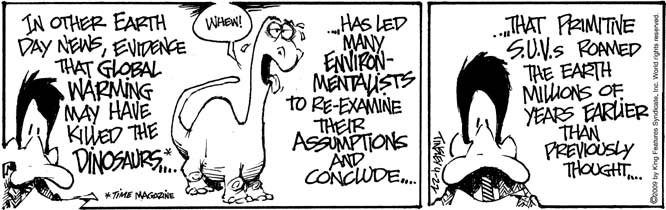
Hat tip: Jay Nordlinger as cited by Edward John Craig writing in NRO's Planet Gore
"When I was a boy I was told that anybody could become President. Now I'm beginning to believe it."
~~~~~ Clarence Darrow

The first patient I ever saw as a first year resident came in with a litany of complaints, not one of which I remember today except for one: he had headaches. The reason I remember he had headaches isn’t because I spent so much time discussing them but rather the exact opposite: at the time I knew next to nothing about headaches and somehow managed to end the visit without ever addressing his at all, even though they were the primary reason he’d come to see me.
Then I rotated on a neurology service and actually learned quite a lot about headaches. Then when my patient came back to see me a few months later, I distinctly remember at that point not only being interested in his headaches but actually being excited to discuss them.
I often find myself thinking back to that experience when I’m confronted with a patient who has a complaint I can’t figure out, and I thought it would be useful to describe the various reactions doctors have in general to patients when they can’t figure out what’s wrong, why they have them, and what you can do as a patient to improve your chances in such situations of getting good care.
 Despite their many differences, though, Tea Partiers pretty well agree on this much: they want the Federal government to be smaller and less intrusive than it has already become. Therefore, they are unalterably opposed to the unprecedented power grabs, massive tax increases, and inconceivably huge deficits which the Obama-Pelosi-Reid triumvirate, aided by the spineless "me, too, but less" Republicans, is attempting to impose upon us.
What sort of language would restore a healthy balance between federal and state power while protecting the liberties of the people?
One simple proposal would be to repeal the 16th Amendment enacted in 1913 that authorized a federal income tax. This single change would strike at the heart of unlimited federal power and end the costly and intrusive tax code. Congress could then replace the income tax with a "uniform" national sales or "excise" tax (as stated in Article I, section 8) that would be paid by everyone residing in the country as they consumed, and would automatically render savings and capital appreciation free of tax. There is precedent for repealing an amendment. In 1933, the 21st Amendment repealed the 18th Amendment that had empowered Congress to prohibit the sale of alcohol.
Alternatively, to restore balance between federal and state power and better protect individual liberty, the repeal of the income tax amendment could be folded into a new "Federalism Amendment" like this:
Section 1: Congress shall have power to regulate or prohibit any activity between one state and another, or with foreign nations, provided that no regulation or prohibition shall infringe any enumerated or unenumerated right, privilege or immunity recognized by this Constitution.
Section 2: Nothing in this article, or the eighth section of article I, shall be construed to authorize Congress to regulate or prohibit any activity that takes place wholly within a single state, regardless of its effects outside the state or whether it employs instrumentalities therefrom; but Congress may define and punish offenses constituting acts of war or violent insurrection against the United States.
Section 3: The power of Congress to appropriate any funds shall be limited to carrying into execution the powers enumerated by this Constitution and vested in the government of the United States, or in any department or officer thereof; or to satisfy any current obligation of the United States to any person living at the time of the ratification of this article.
Section 4: The 16th article of amendment to the Constitution of the United States is hereby repealed, effective five years from the date of the ratification of this article.
Section 5: The judicial power of the United States to enforce this article includes but is not limited to the power to nullify any prohibition or unreasonable regulation of a rightful exercise of liberty. The words of this article, and any other provision of this Constitution, shall be interpreted according to their public meaning at the time of their enactment.

Why are we ignoring things we know? We know that the sun doesn't always shine and that the wind doesn't always blow. That means that solar cells and wind energy systems don't always provide electric power. Nevertheless, solar and wind energy seem to have captured the public's support as potentially being the primary or total answer to our electric power needs.
Solar cells and wind turbines are appealing because they are "renewables" with promising implications and because they emit no carbon dioxide during operation, which is certainly a plus. But because both are intermittent electric power generators, they cannot produce electricity "on demand," something that the public requires. We expect the lights to go on when we flip a switch, and we do not expect our computers to shut down as nature dictates.
Solar and wind electricity are available only part of the time that consumers demand power. Solar cells produce no electric power at night, and clouds greatly reduce their output. The wind doesn't blow at a constant rate, and sometimes it does not blow at all.
If large-scale electric energy storage were viable, solar and wind intermittency would be less of a problem. However, large-scale electric energy storage is possible only in the few locations where there are hydroelectric dams. But when we use hydroelectric dams for electric energy storage, we reduce their electric power output, which would otherwise have been used by consumers. In other words, we suffer a loss to gain power on demand from wind and solar.


If Iran really had advanced weapons, the mullahs wouldn't have to photoshop them all the time, as they do. Most claims by the Islamic Republic have to be heavily discounted to peel off the layers of braggadocio and fantasy, before you get close to the truth. They are true idealists, in the Hegelian sense: They think the idea is more important than the thing itself. So it's no surprise that they make a mess of things. Most everything. Because, you see, they say that everything is great, so don't bother them with real pictures.
The most recent example of the seemingly limitless capacity of Iranian leaders to mess things up comes from Mahmoud Ahmadinejad. He held a campaign rally and offered attendees free oranges. Food being in somewhat short supply these days, lots of folks showed up. And they really did get oranges. Zionist oranges. Jaffa oranges from the land of the little satan. Yes, Ahmadinejad bought Israeli oranges and handed them out to the faithful.
You really cannot invent these people. Not that you'd want to. Ahem.